Dubai, UAE – Pakistan has successfully leveraged the global stage of the Dubai Airshow 2025 to advance the export prospects of its indigenously manufactured and co-developed multirole combat aircraft, the JF-17 Thunder. The highlight of the event was the official announcement of a Memorandum of Understanding (MoU) signed with an unnamed “friendly nation” for the supply of the latest and most advanced iteration of the fighter, the JF-17 Block III.
While a Memorandum of Understanding is non-binding and often described as a preliminary step, the development signifies the growing international confidence in the capabilities and affordability of the JF-17 platform. This export momentum, particularly for the advanced Block III variant, reinforces Pakistan’s position as an emerging player in the global defense export market.
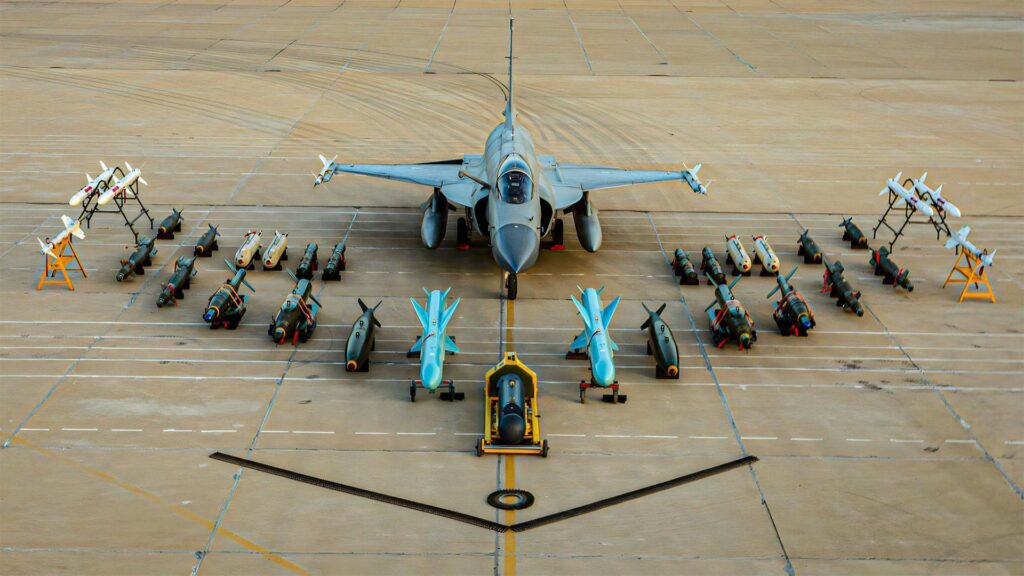
A 4.5-Generation Contender: The JF-17 Block III
The JF-17 Thunder is a cornerstone of the strategic defense cooperation between Pakistan Aeronautical Complex (PAC), Kamra, and China’s Chengdu Aircraft Corporation (CAC). Designed as an affordable, lightweight, multirole fighter, the aircraft has consistently evolved to meet modern aerial warfare requirements.
The newest variant, the JF-17 Block III (or JF-17C), represents a generational leap, placing the fighter firmly in the 4.5-generation category alongside more expensive Western and regional rivals. Key enhancements include:
- Advanced Avionics: A state-of-the-art glass cockpit, a large Holographic Head-Up Display (HUD), and a Helmet-Mounted Display/Sight (HMD/S) significantly reduce pilot workload and enhance situational awareness.
- AESA Radar: The inclusion of an Active Electronically Scanned Array (AESA) radar, such as the NRIET/CETC KLJ-7A, provides superior target detection range (over 105 kilometers), simultaneous tracking of multiple targets, and enhanced resistance to electronic countermeasures.
- Weapons Capability: The Block III is compatible with a wider and more sophisticated array of weaponry, including the long-range PL-15 Beyond Visual Range Air-to-Air Missile (BVRAAM) and the PL-10 high-off-bore-sight short-range missile, offering deadly air-to-air prowess.
- Structural and Service Life: The airframe utilizes a greater proportion of composite materials, extending the operational service life to 4,000 flight hours and a design lifespan of up to 25 years, matching the durability of many “high-tech” competitors. It also features a new under-fuselage hardpoint for increased payload flexibility, though this is an uncommon solution for single-engine fighters due to potential clearance issues.
Joint Production, Export Success, and Key Target Markets
The JF-17 is a product of true collaborative manufacturing. Approximately 60% of the airframe, including the front fuselage section, wings, and tail, is produced at PAC in Kamra, Pakistan. China contributes the middle fuselage, engine compartment, and a significant portion of the critical avionics and general aircraft equipment (GSE). The aircraft is powered by the reliable Russian-made Klimov RD-93MA afterburning turbofan engine (though the use of this engine has led to past, unresolved “sanctions” discussions that Russia can potentially control). The British Martin Baker PK16LE ejection seat is also installed.
Despite not being inducted into the Chinese People’s Liberation Army Air Force (PLAAF), the JF-17 has demonstrated commendable export success:
| Export Customer | Variant | Estimated Contract Size | Significance |
| Azerbaijan | Block III | Up to 40 Aircraft (Approx. $4.6 Billion) | Currently the largest export customer, signifying major regional interest in the advanced variant. |
| Myanmar | Block II | 16 Units | The aircraft’s first foreign sale, validating its performance in diverse operational climates. |
| Nigeria | Block II | 3 Aircraft | Used actively in counter-insurgency operations, proving its ruggedness in African theaters. |
The most likely new customer following the Dubai MoU announcement is Bangladesh. The Bangladesh Air Force (BAF) has been actively seeking new, modern, and cost-effective fighters to replace its aging fleet, a goal that aligns perfectly with the JF-17 Block III’s profile. Reports suggest the MoU could cover a deal for 16 to 24 aircraft. Iraq also remains a serious candidate, reportedly moving towards a firm agreement for 12 Block III fighters. Consistent expressions of interest have also been seen from nations across Africa, the Middle East, and South America, attracted by the JF-17’s competitive unit cost (estimated at $25-30 million per unit) and low maintenance cost.
Battle-Tested Pedigree
Crucially for export promotion, the JF-17 is a battle-proven platform. The Pakistan Air Force (PAF) has actively employed the fighter in counter-terrorism operations against various militant groups and, more notably, in high-stakes aerial confrontations with India.
The PAF has repeatedly emphasized the JF-17’s performance in these clashes, most prominently during the 2019 and very recent skirmishes. Pakistan has claimed that the JF-17, utilizing its advanced air-to-surface capabilities (such as the CM-400AKG missile), successfully struck an Indian S-400 SAM system’s 96L6E all-altitude radar near the city of Adampur—a claim officially denied by New Delhi. Regardless of the counterclaims, the operational deployment in a contested environment provides a powerful testimonial to the aircraft’s combat readiness and effectiveness.
The JF-17 Thunder Block III’s showcasing at the Dubai Airshow 2025 and the subsequent MoU signing underscore its evolution from an affordable replacement fighter to a serious, 4.5-generation multirole contender in the international arms market, with regional air forces like Bangladesh’s signaling a major shift in procurement strategy.
У вас есть невероятно вещь на этом веб-сайте.
Посетите также мою страничку обратная ссылка обязательна https://linksbuilder.fun/
Забронируйте комфортное жильё уже
сегодня и наслаждайтесь комфортным
отдыхом.
гостевой дом лотос адлер
@airbn@b77 https://sutochny.ru
Я обожаю этот веб-сайт – он такой полезный
и полезный. Посетите также мою страничку Как выбрать отелm посуточно https://tiktur.ru/category/zhilyo/
Indexing and indicant checking Service for Google and Yandex.
fast indexing in outlook
Who tin do good from this religious service?
This inspection and repair is utile for site owners and SEO specialists World Health Organization privation to addition their profile in Google and Yandex,
better their web site rankings, and step-up organic traffic.
SpeedyIndex helps cursorily index finger backlinks, fresh pages,
and website updates. speedyindex google scholar https://hipolink.me/speedyindex
Тем, кому нужен платформа для приобретения хороших обратных ссылок, обрати внимание на Prossylki.
Не биржа с тысячами мусорных ссылок, а аккуратная альтернатива под долгосрочное SEO.
Тестировал в Google — без риска
санкций, страницы быстро индексируются, позиции растут
постепенно.
сервис линкбилдинга для SEO https://medic.zkgmu.kz/?option=com_k2&view=itemlist&task=user&id=4733324
Очень хорошо веб-сайт у вас есть иду сюда.
Посетите также мою страничку проверить обратные ссылки на сайт https://orenburg1.ru/senator-afanaseva-raskritikovala-shaman-za-registracziyu-brenda-ya-russkij.html