China has officially revealed detailed imagery of its PL-17 (Pi Li-17) long-range air-to-air missile, marking the first clear public disclosure of a weapon system that has remained largely speculative until now. The image was released on 27 January through Chinese military enthusiast and defense analyst channels. Prior to this, the missile had only been observed in indistinct photographs mounted under the wings of combat aircraft.
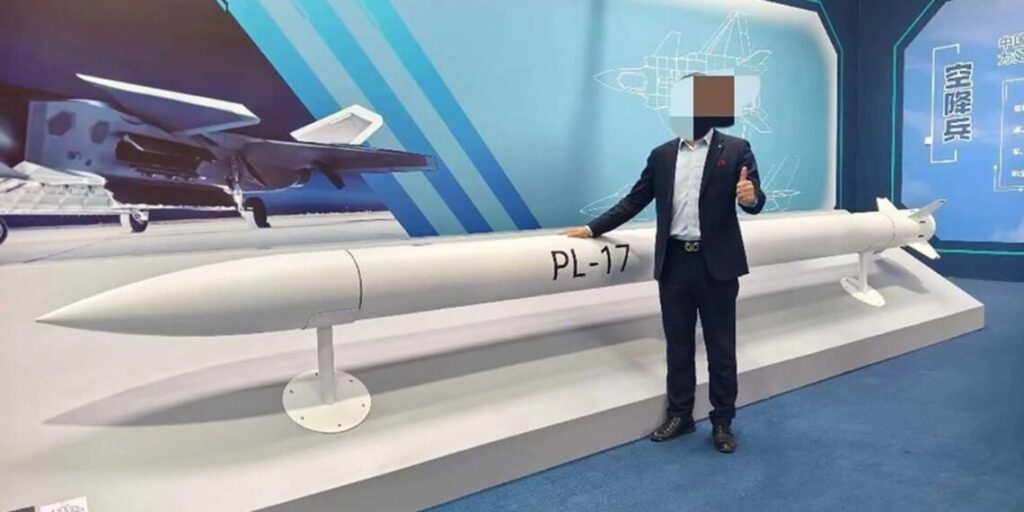
The PL-17 is classified as a very-long-range air-to-air missile (VLRAAM) and has reportedly been in service with the People’s Liberation Army Air Force (PLAAF) since at least 2023. The missile was specifically developed to engage high-value aerial assets, including airborne early warning and control (AEW&C) aircraft, aerial refueling tankers, and airborne command posts operating deep within adversary formations.
Range, Performance, and Design
According to assessments by Western defense analysts, the PL-17 is believed to have an engagement range between 300 and 500 kilometers, placing it well beyond the effective reach of most currently fielded Western air-to-air missiles. This capability positions the PL-17 in the same operational class as Russia’s R-37M, while comparable U.S. systems remain largely in developmental or testing phases.
With an estimated length of approximately six meters, the missile’s size suggests the use of a powerful dual-pulse solid-fuel rocket motor, optimized for long-range engagements. The missile is believed to employ a lofted flight profile, climbing to high altitude before diving onto its target, thereby maximizing range, kinetic energy, and end-game maneuverability. Its estimated top speed exceeds Mach 4, enhancing its ability to intercept fast and distant targets.
Integration with Carrier Aircraft
The PL-17 is currently deployed on external pylons of several aircraft in Chinese service, including the J-16 multirole fighter, J-10C, and Chinese-operated Su-30MKK and Su-35 fighters. Its external carriage reflects its size but also suggests employment in missions where stealth is secondary to long-range air denial.
Future integration is anticipated with larger, low-observable platforms, such as the projected J-36 next-generation aircraft. The possibility of external carriage on the fifth-generation J-20 remains a topic of ongoing discussion, though such integration would likely compromise the aircraft’s stealth characteristics.
Guidance and Targeting Architecture
During the mid-course phase, the PL-17 reportedly relies on an inertial navigation system, updated via satellite links and two-way datalinks, allowing for dynamic retargeting. In the terminal phase, the missile transitions to an active radar seeker, supplemented by passive sensors, significantly complicating enemy electronic warfare and countermeasure efforts.
Effective employment of the PL-17 at maximum range is dependent on external target cueing, provided by AEW&C aircraft, satellites, ground-based radar systems, or other airborne platforms. This highlights the missile’s role within a network-centric warfare framework, rather than as a standalone weapon.
Strategic Implications
The development and deployment of the PL-17 form a key component of China’s broader strategy to push U.S. and allied air power farther from contested operational zones, particularly in the Asia-Pacific region. When paired with capable carrier aircraft such as the J-16, armed with PL-17 missiles, the system presents a credible threat to critical enablers of NATO-style air operations, including surveillance, command, and aerial refueling assets.
By targeting these high-value nodes, the PL-17 enhances China’s ability to degrade adversary air operations without engaging frontline fighter formations directly, reinforcing its growing emphasis on long-range precision and anti-access/area-denial (A2/AD) capabilities.