Pakistani Prime Minister Muhammad Sharif has officially confirmed the transfer of JF-17 Thunder fighter jets to the Azerbaijani Air Force. The aircraft had already appeared publicly on 8 November 2025 during a military parade in Baku, signaling the beginning of a significant modernization phase for Azerbaijan’s air capabilities.
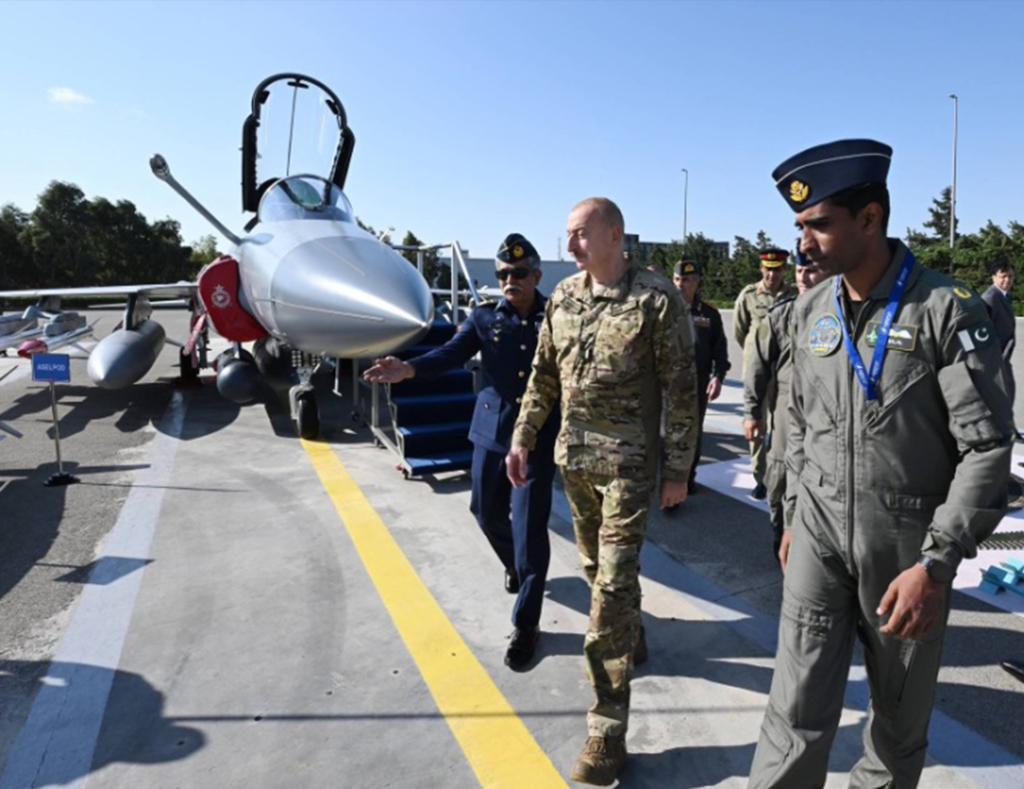
Five JF-17 Block III fighters took part in joint military exercises between Pakistan and Azerbaijan in October. Observers noted that while the aircraft retained their original serial numbers, they no longer displayed Pakistani Air Force insignia—an indication that the jets were in the process of transitioning to full Azerbaijani service. With this acquisition, Azerbaijan becomes the fourth operator of the JF-17, following Pakistan, Myanmar, and Nigeria. Additional customers may emerge in the future, with Iran frequently cited as a potential operator.
The initial contract for the JF-17, valued at $1.6 billion, was signed in February 2024. In the summer of 2025, the two countries concluded a second agreement for 40 additional aircraft, worth $4.6 billion. Combined, these deals represent the largest defense export contract in Pakistan’s history. Deliveries will occur in multiple stages and will include comprehensive training programs for Azerbaijani flight and technical personnel, coordinated with pilot instruction and the integration of Baku’s existing weapons systems.
The JF-17—known as the FC-1 Xiaolong in China—is a fourth-generation lightweight multirole fighter jointly developed by China and Pakistan. Although not officially confirmed, Russian engineers reportedly contributed significantly during the aircraft’s early development phase. The fighter is equipped with a KLJ-7A AESA radar, a wide-angle holographic head-up display, a missile approach warning system, and a modern digital flight-control system. It is powered by the Russian-built RD-93 turbofan engine.
The aircraft can carry up to 1,500 kg of ordnance, including PL-15E and PL-10E air-to-air missiles, precision-guided bombs, and anti-ship or anti-radiation missiles. The two-seat JF-17B variant supports advanced pilot training. Production responsibilities are divided between China (42%) and Pakistan (58%), with final assembly conducted at the Pakistan Aeronautical Complex (PAC) in Kamra. More than 350 units have been produced to date, with roughly 160 currently serving in the Pakistan Air Force.
For Azerbaijan, the induction of the JF-17 represents a major step in upgrading its aging fleet, which currently consists of around twenty ex-Soviet MiG-29 and Su-25 aircraft. The primary operating base for the new fighters will be Nasosnaya Airfield, historically one of the most important airbases during the Soviet era.
While media reports emphasize that the procurement highlights the deepening strategic partnership between Pakistan and Azerbaijan, the broader implications suggest a shift in Baku’s defense alignments. Analysts note that the move not only reduces Azerbaijan’s long-standing dependence on Moscow but also strengthens its ties with Beijing, whose role in the JF-17 program remains central.