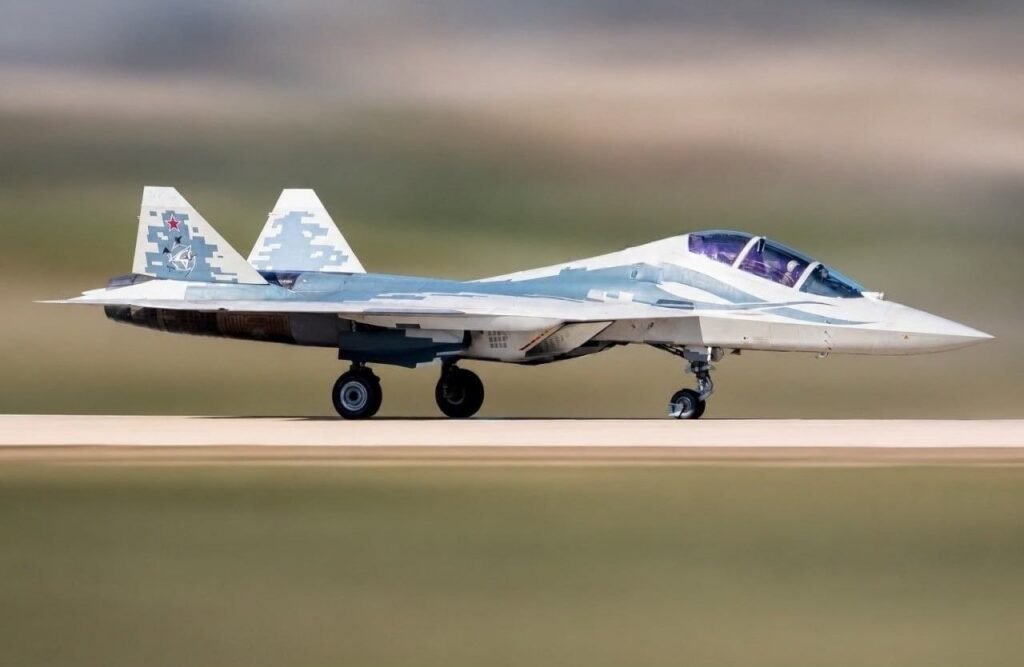
The emergence of the two-seat Su-57D has reignited discussions about Russia’s long-term strategy for its fifth-generation fighter program. While the aircraft itself does not appear technically mysterious, its real significance lies in geopolitics, export ambitions, and the revival of stalled international partnerships—particularly with India.
The Return of an Old Idea
To understand the purpose of the Su-57D, it is necessary to revisit the history of the Russian-Indian FGFA (Fifth Generation Fighter Aircraft) program. The concept of joint development between Moscow and New Delhi dates back to 2001, when both governments agreed to cooperate on a next-generation stealth fighter. However, despite early enthusiasm, the actual design contract was only finalized nearly a decade later.
Problems emerged quickly. India’s long-standing objective was not merely to buy advanced weapons, but to transform itself from an arms importer into a defense exporter capable of designing indigenous systems. New Delhi wanted deeper access to technology and greater participation in the aircraft’s development process.
This issue had already appeared in another Russian-Indian aviation project—the MTA (Multirole Transport Aircraft) program based on the Il-214 concept. Indian demands reportedly led to repeated redesign studies involving payload, range, wing configurations, and engine options such as the PS-90 and PD-14M. Eventually, the project stalled and India withdrew, later purchasing American C-130 and C-17 transport aircraft instead.
The FGFA Dispute
In the FGFA fighter program, India hoped for broader involvement and reportedly showed interest in a design linked to the Mikoyan bureau’s proposal that had lost against Sukhoi’s T-50 during the PAK FA competition. However, Russia insisted that the T-50 platform remain the foundation of the project.
Another major disagreement involved the cockpit configuration. At the time, the Russian Air Force considered a dual-seat version unnecessary and prioritized a single-seat fighter configuration. India, however, sought greater flexibility and potentially more operational control through broader customization.
By 2018, the partnership had effectively collapsed. Although there was no formal public cancellation announcement, Indian officials and media reports indicated that New Delhi had withdrawn due to unresolved disputes over finances, technology transfer, and development participation.
Why the Su-57D Matters Now
The recent unveiling of the two-seat Su-57D suggests that Moscow may be revisiting earlier export requirements that were previously rejected. Statements from officials at the Wings India air show, including comments from UAC head Vadim Badeha and Deputy Prime Minister Denis Manturov, emphasized that the dual-seat variant could attract foreign buyers.
This timing is unlikely to be accidental.
Russia’s position in the Indian defense market has weakened in recent years as New Delhi diversified its suppliers and increased cooperation with Western manufacturers. By introducing the Su-57D, Russia may be attempting to offer India a platform that better matches the operational and industrial expectations that existed during the FGFA negotiations.
Combat and Operational Advantages
Beyond export politics, a dual-seat fifth-generation fighter offers practical military advantages.
A second crew member can assist with:
- Coordinating drone operations and loyal wingman UAVs
- Managing electronic warfare systems
- Conducting long-range strike missions
- Processing battlefield data in complex environments
- Reducing pilot workload during multi-domain combat
As air combat becomes increasingly network-centric, the role of a dedicated weapons systems officer or mission operator becomes more valuable. Similar concepts are already visible in other advanced fighter programs worldwide.
For Russia, the Su-57D could therefore serve both as an export-oriented platform and as a future command-and-control node for manned-unmanned teaming operations.
India Remains the Key Target
Although India has not officially commented on the Su-57D proposal, the direction of Russian messaging strongly suggests that New Delhi remains the primary focus. The dual-seat configuration addresses one of the earlier conceptual gaps in the FGFA negotiations while simultaneously offering a platform tailored for future air combat doctrines.
Whether India will return to the program remains uncertain. However, the Su-57D appears to represent more than just a new aircraft variant—it is also a renewed attempt by Moscow to rebuild strategic influence in one of its most important defense markets.