Current force deployments indicate that the United States and Israel possess a substantial military aviation presence in the Middle East, capable of conducting a large-scale air and missile strike against targets inside Iran should a decision be made to do so.
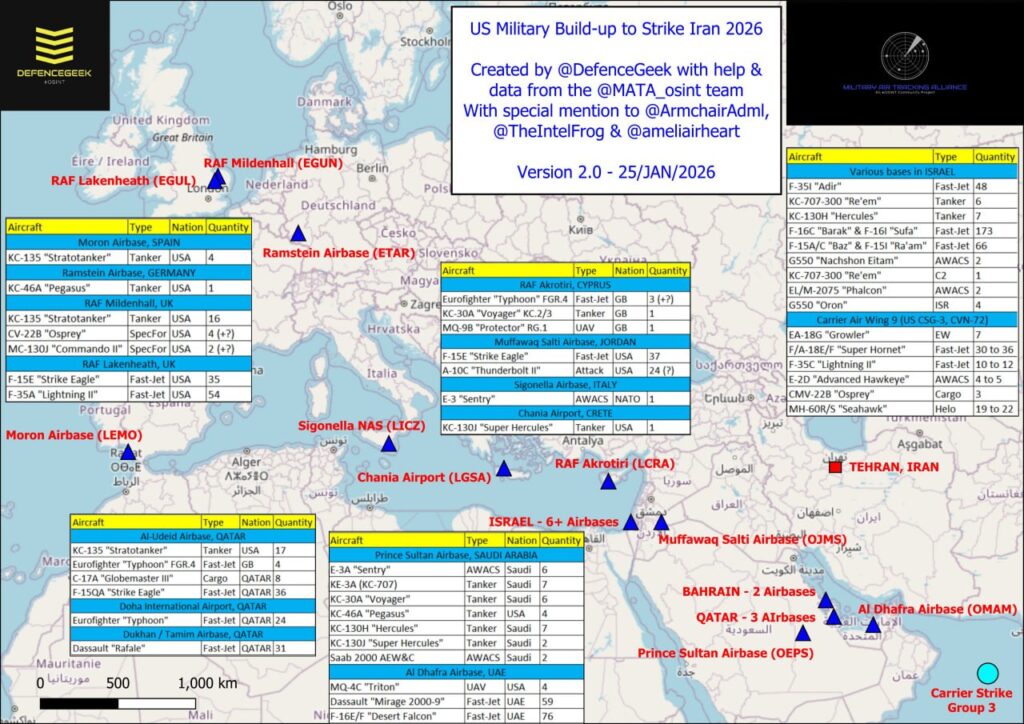
A key component of this posture is the extensive deployment of aerial refueling assets. Traditionally, tanker aircraft form the backbone of long-range strike operations, enabling sustained sorties by tactical and strategic aviation. At present, approximately 20 U.S. tanker aircraft and around 13 Israeli tankers are reportedly positioned in the region, providing the necessary logistical support for extended air operations.
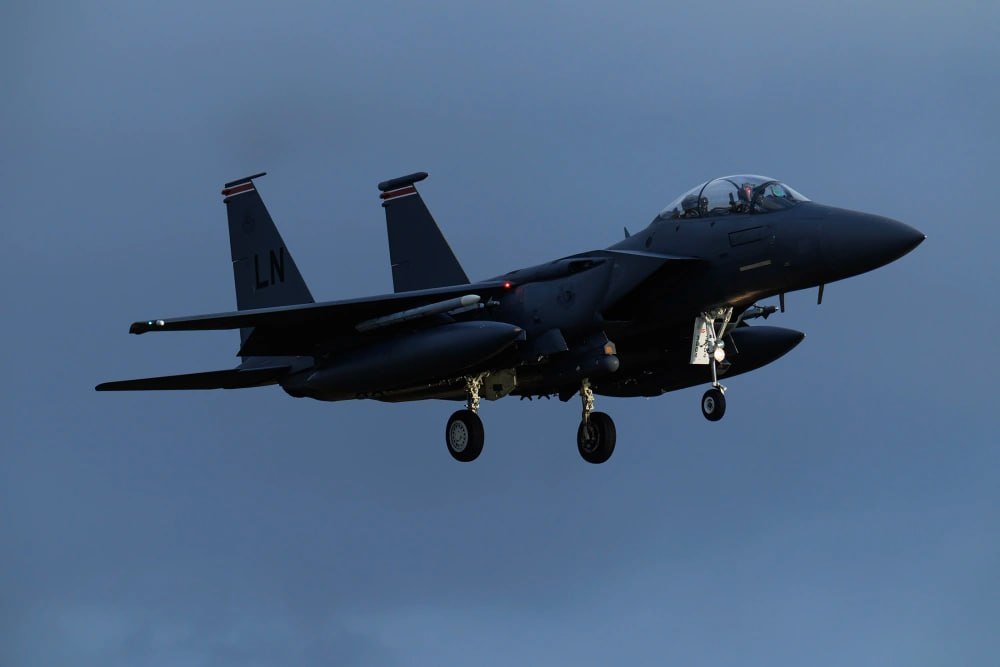
In close proximity to Iranian airspace, the U.S. Air Force has deployed 37 F-15E Strike Eagle multirole strike fighters. In addition, the U.S. Navy aircraft carrier USS Abraham Lincoln has arrived in the region, bringing with it approximately 10 F-35C Lightning II fifth-generation fighters and around 30 F/A-18E/F Super Hornet multirole combat aircraft. This carrier-based air wing significantly enhances strike flexibility and sortie generation capacity.
Israel’s own air power remains a central element of any potential operation. The Israeli Air Force fields 48 F-35I Adir stealth fighters, complemented by a large fleet of fourth-generation aircraft, including approximately 173 F-16 fighters and 66 F-15 fighters of various modifications. This combination provides Israel with both deep-strike capabilities and a high volume of precision-guided munitions delivery platforms.
Additional U.S. assets deployed in the region include 24 A-10C Thunderbolt II attack aircraft. While it is considered unlikely that these aircraft would be used for direct strike missions against heavily defended targets, they could be employed in auxiliary roles, such as countering unmanned aerial systems using APKWS II laser-guided rockets.
One of the more limited elements of the current force structure is the relatively small number of airborne early warning and control (AEW&C) platforms. Even when accounting for the E-2D Hawkeye aircraft embarked aboard USS Abraham Lincoln, the number of AWACS assets appears constrained. However, it remains possible that not all deployed aircraft are publicly accounted for, or that additional AEW&C platforms could be introduced if the operational situation requires.
Overall, the U.S. and Israeli forces currently deployed in the Middle East appear sufficient to conduct powerful, though potentially short-duration, air and missile strikes against Iran. Under such conditions, Iran would face severe challenges in mounting an effective defense.
Previous developments have demonstrated the limited ability of Iranian air defense systems and air force assets to withstand sustained air campaigns, even when facing operations conducted primarily by Israel, with direct U.S. involvement occurring only in later stages. In a scenario where U.S. Air Force and Navy tactical aviation, strategic bombers, and cruise missile platforms are engaged from the outset—particularly in light of prior attrition suffered by Iranian air defense networks—the outlook for Iran would be considerably more unfavorable.
Ultimately, the scale and duration of any such operation would depend on political decision-making in Washington. Much would hinge on how many resources a U.S. administration under President Donald Trump would be willing to commit and for how long. Based on his previous approach to military engagements, a prolonged campaign appears unlikely. Nevertheless, the forces currently positioned in the region are adequate to support a significant initial strike phase.