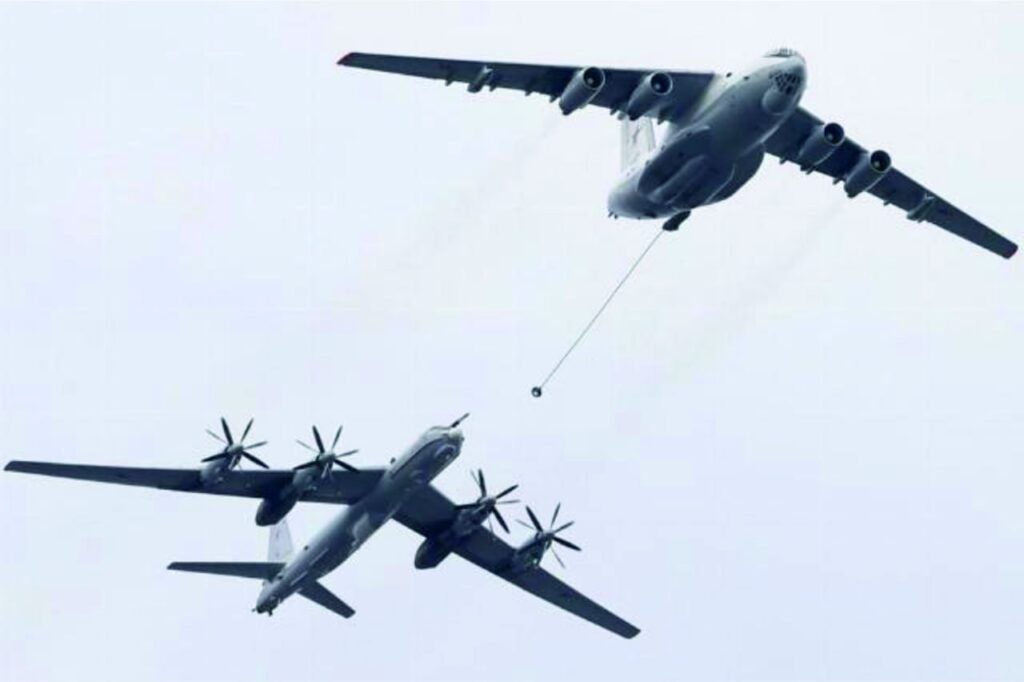
The Russian Navy’s Tu-142MK long-range anti-submarine warfare (ASW) aircraft has conducted its first recorded in-flight refueling mission over the Arctic region, according to official sources. The aircraft is operated by the Northern Fleet’s naval aviation component, and the mission marked a notable milestone in the operational employment of Russia’s maritime patrol aviation.
While the event has attracted attention due to its geographic and historical significance, its importance lies primarily in the operational implications rather than its symbolic value.
Aircraft Background and Capabilities
The Tu-142 first flew in 1968 and entered service in the early 1970s. Developed from the Tu-95 strategic bomber platform, it remains one of the most capable variants within the Tu-95 family, particularly in terms of onboard mission systems and endurance. The Tu-142MK modernization variant incorporates improved avionics, navigation systems, and anti-submarine warfare equipment.
Designed for long-range maritime patrol and ASW missions, the aircraft is tasked with detecting, tracking, and targeting submarines, coordinating with other ASW assets, and maintaining communications with friendly submarines at sea. Its payload can include a wide range of sonobuoys, anti-submarine torpedoes, depth charges, naval mines, and ASW missiles. Depending on configuration, the crew typically consists of nine to ten personnel.
Endurance as a Key Operational Factor
For anti-submarine aircraft, endurance is a critical performance parameter. The Tu-142 can remain airborne for approximately 12 hours without refueling. Aerial refueling significantly extends this capability, allowing patrol durations exceeding 24 hours. During the Arctic mission, total flight time reportedly reached approximately 30 hours, demonstrating the practical impact of in-flight refueling on sustained ASW coverage.
Challenges of Arctic Operations
Conducting long-range flights in high-latitude regions presents distinct operational challenges. Navigation and communications can be degraded due to geomagnetic effects, which complicates rendezvous procedures between tanker and receiver aircraft. The scarcity of alternate airfields in the Arctic increases mission risk and crew workload, while weather conditions in the region are known for rapid and unpredictable changes.
Successfully completing an aerial refueling under such conditions indicates a high level of crew training, planning, and coordination, as well as improved confidence in operating complex missions in polar environments.
Strategic Context
According to Russian state media, the flight has been entered into the record book of the Russian Armed Forces. From a strategic perspective, the mission aligns with broader efforts to enhance the persistence and reach of maritime patrol aviation in the Arctic and North Atlantic regions.
The Northern Fleet plays a central role in protecting key naval bases that host a substantial portion of Russia’s sea-based nuclear deterrent. In addition to these bases, critical energy infrastructure in northern Russia—particularly major pipeline junctions and coastal facilities—represents assets of strategic importance that require layered surveillance and protection.
Modern submarine platforms armed with long-range cruise missiles have increased the importance of early detection and continuous monitoring in Arctic and sub-Arctic waters. Extended-endurance ASW aircraft contribute to this mission by maintaining persistent patrols over wide maritime areas, particularly in regions where surface and ground-based sensors are limited.
Operational Implications
The successful refueling of a Tu-142MK over the Arctic suggests an expansion of operational flexibility for Russia’s naval aviation forces. Increased endurance allows for longer patrols, broader coverage, and reduced gaps in ASW surveillance, especially in northern maritime approaches.
From a defense planning perspective, such capabilities strengthen deterrence by improving the monitoring of undersea activity and reducing vulnerabilities associated with long-range submarine operations. Rather than signaling immediate intent, the mission demonstrates an emphasis on readiness, sustainability, and the ability to operate effectively in demanding environments.
Conclusion
The Arctic aerial refueling mission of the Tu-142MK represents a meaningful development in Russia’s maritime aviation capabilities. By extending flight endurance in one of the world’s most challenging operational theaters, the Northern Fleet’s ASW forces enhance their capacity to protect strategic assets and maintain situational awareness in key maritime regions. The event underscores the growing importance of long-range, persistent air operations in modern naval defense planning.