China has conducted the maiden flight of a new military transport aircraft, marking a significant milestone for the country’s aviation industry after more than a decade of largely confidential development. Footage of the first flight has recently surfaced online, providing the first public glimpse of the aircraft in operational form.
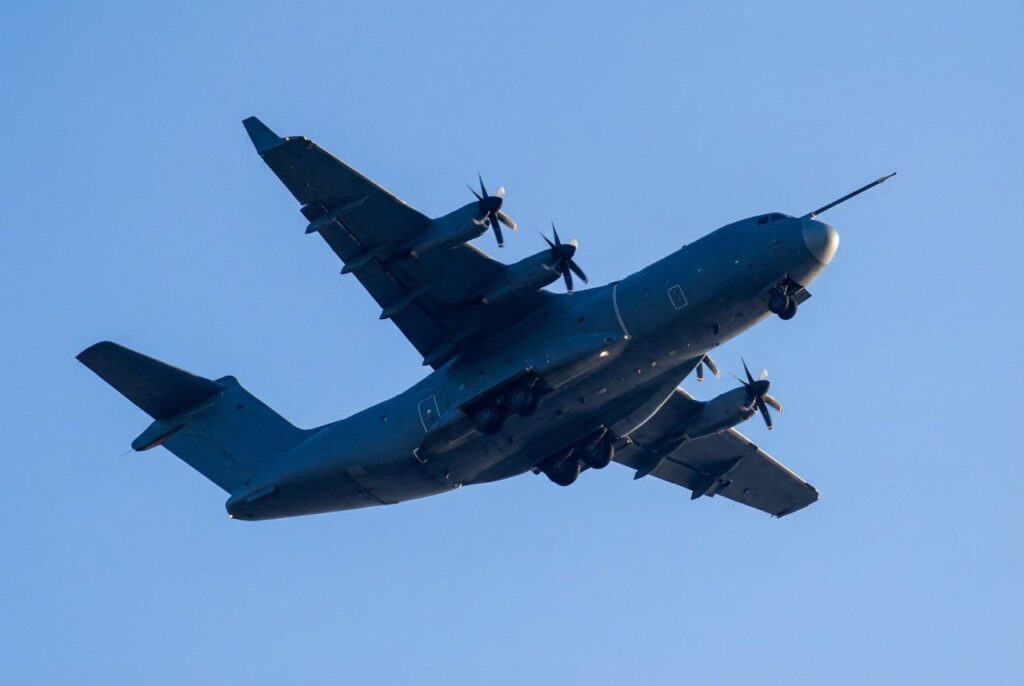
According to aviation observers, the aircraft was filmed in the vicinity of the Xi’an Aircraft Corporation (XAC) airfield in Xi’an. XAC, a major subsidiary of the Shaanxi Aircraft Corporation, is a key manufacturer of military transport and special-mission aircraft for the People’s Liberation Army (PLA). Although the available images and videos are of limited quality, they offer sufficient detail to draw preliminary conclusions about the aircraft’s configuration and intended role.
Background and Development History
Information about this transport aircraft has circulated for several years. A scale model was first displayed by the Shaanxi Aircraft Corporation at the Zhuhai Airshow in 2014, where it carried the designation Y-30. Notably, eyewitnesses reported that the designation was covered up on the second day of the exhibition, suggesting that the name was either provisional or prematurely disclosed. In subsequent years, the project was referred to in open sources as Y-9M or simply as a “new transport aircraft.”
At the 2014 exhibition, a specification poster accompanied the model. While these figures likely represented target performance goals rather than finalized characteristics, they provide useful insight into the aircraft’s conceptual design:
- Cruising speed: 600 km/h
- Service ceiling: 10,000 m
- Maximum range with full payload: 3,000 km
- Endurance: up to 12 hours
- Takeoff / landing distance: 1,200 m / 1,100 m
- Maximum payload: 20 tonnes
- Personnel capacity: up to 110 troops
Role Within China’s Airlift Fleet
Initial expert assessments suggested that the Y-30 was intended to bridge the gap between the Y-9 and the larger Y-20 strategic transport aircraft. However, if the above payload figures remain accurate, this interpretation appears questionable. The Y-9 already offers a payload in the 20–25 tonne class, while the Y-20—according to recent reports—has seen its payload capacity increase to approximately 30 tonnes or more.
In this context, the Y-30 is more plausibly viewed as a long-term replacement for the Y-8 and Y-9 family of transports, which themselves are derived from the An-12 design. These aircraft form the backbone of PLA Air Force, Army Aviation, and Naval Aviation transport fleets, with more than 150 units in service. A modern replacement would therefore be produced in substantial numbers, with strong export potential for allied and partner nations seeking a medium tactical airlifter.
Design Features and Operational Capabilities
Visual evidence from the first flight indicates that the Y-30 is optimized for operations from austere or semi-prepared airfields. Its robust landing gear, fitted with large-diameter wheels, supports this assessment. The aircraft features a relatively wide, “thick” fuselage, suggesting increased internal volume compared to the Y-9, which would enhance cargo flexibility and troop transport capacity.
The overall configuration is conventional for a military transport aircraft, including a high-mounted straight wing, a T-tail arrangement, and winglets at the wingtips. The absence of wing sweep is consistent with an emphasis on low-speed handling and reduced landing speeds—key requirements for tactical airlift missions.
Significance for China’s Aviation Industry
The successful first flight of the Y-30 caps a notably productive year for China’s aerospace sector. Alongside this program, the industry has unveiled or advanced numerous unmanned aerial vehicles, fixed-wing aircraft, tiltrotor platforms, and rotary-wing designs. Collectively, these developments underscore the growing maturity and breadth of China’s aviation capabilities, particularly in the military domain.
As flight testing progresses and official information becomes available, the Y-30 is expected to play a central role in modernizing China’s medium airlift fleet and strengthening its expeditionary and logistical capabilities.