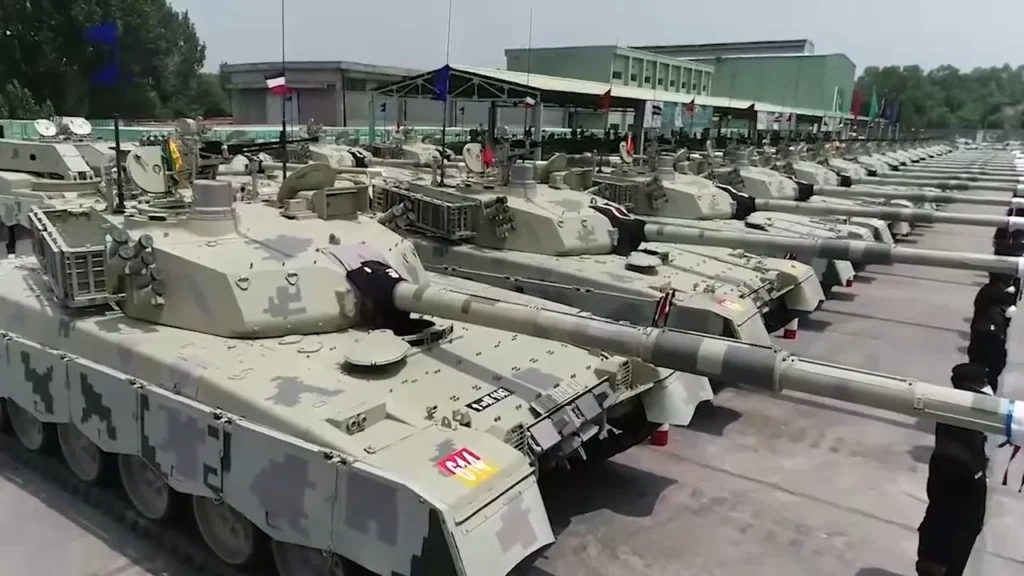
The Al-Khalid tank is the centerpiece of Pakistan’s armored warfare doctrine and a testament to its transition from a defense importer to a developer of high-end military technology. Named after the legendary 7th-century commander Khalid bin al-Walid, the tank was specifically designed to handle the diverse and grueling environments of Pakistan—from the humid plains of Punjab to the extreme heat of the Thar Desert.
Background and Strategic Necessity
The inception of the Al-Khalid project in the late 1980s was driven by a critical need for modernization. At that time, the Pakistan Army’s armored corps was primarily equipped with aging platforms like the Type 59 and Type 69, which were based on 1950s Soviet technology. While these tanks were reliable, they lacked the firepower, protection, and electronic warfare capabilities of modern 3rd-generation MBTs.
The goal was not just to buy a new tank, but to establish a domestic production facility. This led to the creation of Heavy Industries Taxila (HIT), which became the hub for the “Tank Al-Khalid” project. The initiative aimed to ensure that the army could maintain its qualitative edge in the region without being entirely dependent on foreign suppliers who might impose sanctions during times of conflict.
The MBT-2000 Joint Venture
The Al-Khalid is the result of a profound collaboration between Pakistan and China, specifically with North Industries Corporation (NORINCO). The development was based on the Chinese Type 90-II prototype, often referred to as the MBT-2000 for the export market. This joint venture was a multi-stage program that involved significant technology transfer.
Early in the project, designers tested various international components, including French engines and German transmissions. However, following the 1998 nuclear tests and subsequent international sanctions, Pakistan pivoted toward a more robust partnership with Ukraine for propulsion systems. This culminated in the integration of the Ukrainian 6TD-2 engine. By 2001, the first production units were officially handed over to the Pakistan Army, marking the successful indigenization of a 3rd-generation tank platform.
Design and Ergonomics
The Al-Khalid follows the Eastern design philosophy, which favors a low silhouette and reduced weight to maximize stealth and mobility. By utilizing a three-man crew (commander, gunner, and driver) and an automatic loader, the tank eliminates the need for a fourth crew member. This allows the turret to be significantly smaller and less vulnerable to enemy fire compared to Western tanks like the M1 Abrams.
The tank weighs approximately 46 to 48 tons, which is ideal for the local geography. Pakistan’s extensive canal system and bridge infrastructure have specific load limits; a 70-ton Western tank would face severe mobility restrictions in these areas, whereas the Al-Khalid can navigate them with ease.
Armament and Firepower
The primary weapon of the Al-Khalid is a 125mm smoothbore gun, which is manufactured at HIT using high-strength electroslag remelting steel. This gun is capable of firing several types of munitions:
- APFSDS (Armor-Piercing Fin-Stabilized Discarding Sabot): Most notably, the “Naiza,” a Pakistani-developed depleted uranium round that can penetrate 570mm of armor at a distance of 2 km.
- HEAT-FS and HE-FS: High-explosive rounds designed for anti-tank and anti-personnel roles.
- ATGMs: The gun can launch laser-guided anti-tank missiles, such as the Ukrainian “Kombat,” allowing the tank to engage targets at ranges of up to 5 km.
The tank features an advanced computerized Fire Control System (FCS) with a “Hunter-Killer” capability. This allows the commander to independently search for and acquire a second target while the gunner is still engaging the first, significantly increasing the tank’s combat efficiency.
Armor and Survivability
Protection on the Al-Khalid is modular, combining composite armor with Explosive Reactive Armor (ERA). The tank is often seen with the FY-2 or the more advanced FY-4 ERA tiles, which are designed to neutralize incoming shaped-charge warheads and kinetic energy penetrators.
Beyond physical armor, the tank incorporates:
- Automatic Fire Suppression: High-speed sensors that detect and extinguish internal fires within milliseconds.
- NBC Protection: An over-pressure system to keep the crew safe in nuclear, biological, or chemical environments.
- Low Signatures: The design minimizes thermal and acoustic signatures to make it harder for enemy sensors to track.
Mobility and Propulsion
The “heart” of the Al-Khalid is the Ukrainian 6TD-2 6-cylinder multi-fuel diesel engine. Delivering 1,200 horsepower, it provides the tank with an impressive power-to-weight ratio of roughly 26 hp/ton. This allows the tank to reach a top speed of 72 km/h on roads and maintain high speeds over rugged terrain.
A standout feature is its reverse speed. Unlike many Soviet-legacy tanks that struggle to reverse quickly, the Al-Khalid can reverse at speeds of up to 31 km/h, allowing it to “shoot and scoot” or retreat rapidly under fire. It also possesses a deep-fording capability, allowing it to cross water obstacles up to 5 meters deep with preparation.
The Al-Khalid-1 Modernization
Introduced officially in 2020, the Al-Khalid-1 is an iterative upgrade that addresses the demands of the modern digital battlefield. The improvements are extensive:
- Solid State Autoloader (SSAL): Replaces older mechanical systems with digital controls for better reliability.
- Improved Electronics: Enhanced multi-process fire control computers and high-resolution third-generation thermal imagers for both the commander and gunner.
- Battle Management System (IBMS): A digital network that allows the tank to share real-time target data with other units and headquarters.
- Crew Comfort: The addition of a high-performance air conditioning system is crucial for crew endurance during long operations in the Sindh and Balochistan deserts.
Current Numbers and Strategic Importance
As of late 2025, it is estimated that Pakistan operates approximately 600 tanks in the Al-Khalid series, with more than 110 of these being the upgraded Al-Khalid-1 variant. These tanks form the “Spearhead” of the Army’s strike formations, particularly the Independent Armored Brigades.
The strategic importance of the Al-Khalid lies in its ability to provide qualitative parity against regional competitors, such as India’s T-90 “Bhishma” fleet. By maintaining a locally produced, high-performance platform, Pakistan ensures that its armored corps remains a credible deterrent. The Al-Khalid program has not only bolstered national security but also fostered a sophisticated industrial ecosystem that is currently working toward the next evolution, the Al-Khalid-2 and the Haider (VT-4) programs.